Les fondations en mouvement
Pas & mouvements
Les noms, les origines et les histoires des mouvements qui ont façonné le Locking.
35 pas et mouvements
Les pas et mouvements du Campbellocking et du Locking ne sont pas nés sous la forme d’une liste fermée. Don Campbell y a intégré ses propres idées et des éléments déjà présents autour de lui, tandis que d’autres pionniers créaient, transformaient, nommaient et combinaient des mouvements au fil du développement de la danse.
Une partie de ce vocabulaire s’appuie sur des gestes déjà employés au quotidien — pointer du doigt, saluer ou se taper dans la main — ainsi que sur des social party dances. D’autres éléments ont des précédents plus anciens dans l’African American vernacular jazz dance et les claquettes, notamment le travail rythmique des pieds, les splits, l’acrobatie et la présence scénique. Ces formes s’inscrivent dans un continuum afrodiasporique plus vaste, lié à des pratiques de danse africaines traditionnelles. Cela ne signifie pas que chaque pas ci-dessous possède une source unique et directe : le Locking s’est développé par héritage, échange, transformation et invention nouvelle dans le Los Angeles afro-américain.
01
BASIC LOCK
Le Basic Lock consiste à suspendre ou figer les bras sur les temps de la musique. Don Campbell l’a créé à la fin des années 1960 ou au début des années 1970, lorsqu’il s’arrêtait en essayant une social dance populaire appelée Funky Chicken. Ces pauses furent appelées locks, ou locking up.
02
DOUBLE LOCK
Le Double Lock répète le lock deux fois de suite, créant une sensation de rebond et une accentuation rythmique. On peut voir Don Campbell employer cette approche lors de ses premières apparitions dans Soul Train avec Damita Jo Freeman : la répétition du lock permet à la fois de marquer le temps et de façonner son timing personnel.
03
THE LEO LOCK
Leo « Fluky Luke » Williamson a développé ce lock caractéristique en posant le bord extérieur des deux mains sur la taille et en verrouillant les coudes vers l’avant. Sa souplesse exceptionnelle donnait à la position une forme très marquée, reprise ensuite par d’autres lockers souples.
04
GIVING OR ASKING FOR FIVE
Ce hand slap exprime un accord entre deux personnes, ou avec soi-même pendant la danse. Don Campbell l’intégrait entre ses locks et ses social dances. Donner ou recevoir un five était depuis longtemps un geste de reconnaissance dans la communauté afro-américaine, bien avant son intégration à la danse. Lorsque les gens souriaient et approuvaient un mouvement, Don et d’autres pionniers tendaient souvent la main pour recevoir un five ; répondre par une tape signifiait accepter ce signe d’approbation.
05
LOCKING POINTS
Ces points furent ensuite appelés Uncle Sam points, en référence à l’affiche de recrutement des forces armées américaines où le personnage d’Uncle Sam pointe vers le spectateur. Pointer vers un ami ou un partenaire constituait aussi un message et un signe de reconnaissance dans la communauté afro-américaine, notamment pour saluer quelqu’un à distance, avant que Don Campbell ne l’intègre à son style. Selon le récit, une femme assise à une table riait de sa manière singulière de danser ; Don a alors fait ce que tout le monde faisait et l’a pointée pour lui montrer qu’il l’avait vue. Ce fut le premier point élémentaire du Locking. Avec le développement de la danse, d’autres pionniers ont introduit des doubles et triples points qui ont fluidifié son rythme.
06
HAND CLAPS
Les back hand claps et back-front hand claps étaient également fondamentaux au début. Marqués par des départs et arrêts brusques, ils étaient souvent exécutés seuls pendant le pacing ou entre d’autres mouvements. Don intégra aussi les premiers wrist rolls à son style. Par la suite, diverses combinaisons de wrist rolls et d’autres mouvements furent placées avant les back-front hand claps, contribuant à la continuité et à l’évolution de la danse.
07
UPLOCK
L’Uplock, souvent appelé aujourd’hui Muscle Man, consiste à lancer les deux bras vers le haut, généralement au début d’un mouvement de Locking. C’est une annonce comparable à un geste de salutation dans la rue : « Hey » ou « What’s up? »
08
PACE / KEEPING TIME
Le Pace, aussi appelé Keeping Time, est un mouvement rythmique fondamental qui permet de garder le tempo et de relier les mouvements de Locking. Un bras est lancé sur le côté, loin du corps, au rythme de la musique. Le geste peut rappeler la manière dont les musiciens et le public de jazz marquent la pulsation ; dans le Locking, il peut aussi prendre un caractère plus proche de la marche ou du mouvement militaire.
09
WRIST TWIRL / WRIST ROLLS
Les wrist twirls, aussi appelés wrist rolls ou rolls, sont un mouvement fondamental du Locking. Les mains fermées, les poignets tournent dans un mouvement fluide au rythme de la musique, qui peut se terminer par un lock ou un arrêt net. Don Campbell a intégré les premiers wrist rolls à son style, et des combinaisons ultérieures ont contribué à créer de la continuité entre les mouvements.
10
THE DON CAMPBELL WALK
Créé par Don Campbell, ce déplacement glissé lui permettait d’avancer entre ses locks et ses stunts.
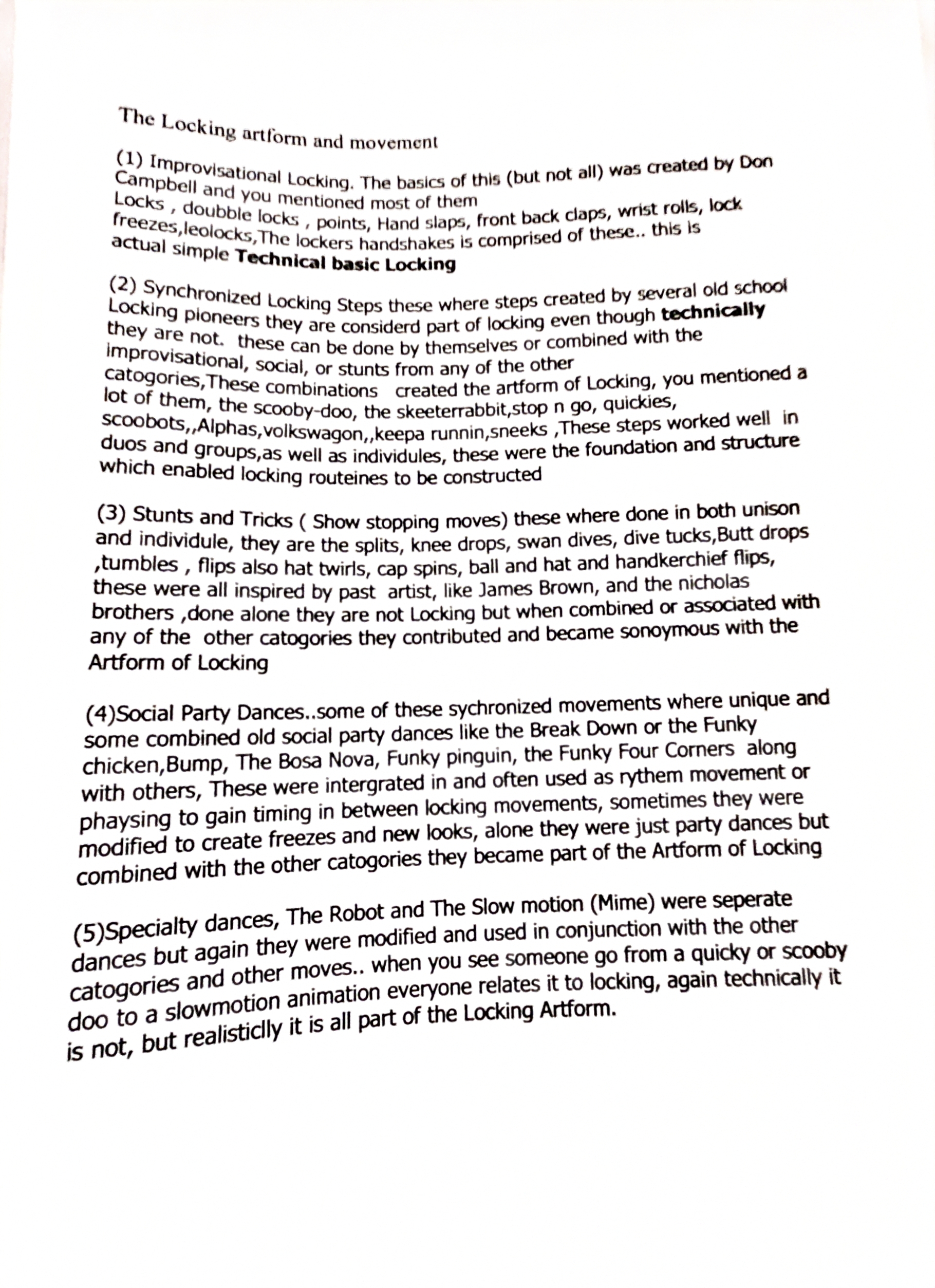
Un document d’O.G. Skeeter Rabbit
Cinq composantes qui, ensemble, forment le Locking
O.G. Skeeter Rabbit a décrit cinq familles de mouvements pour montrer que le Locking dépasse largement un seul geste. Ces composantes peuvent exister séparément, mais elles prennent une fonction particulière lorsqu’elles sont associées au timing, au caractère et aux locks de la danse.
- 01
Improvisational Locking
Improvisation et bases techniques
Locks, points, hand slaps, wrist rolls, freezes et autres mouvements fondamentaux utilisés en freestyle.
- 02
Synchronized Locking Steps
Pas de Locking synchronisés
Pas développés par plusieurs pionniers et utilisés en solo, en duo ou en groupe pour construire des routines.
- 03
Show-stopping moves
Cascades et tricks
Splits, knee drops, dives, flips et tricks avec accessoires qui deviennent partie intégrante du Locking lorsqu’ils sont reliés au reste de son langage.
- 04
Social Party Dances
Social party dances
Les danses sociales de l’époque apportent groove, timing et transitions entre les mouvements de Locking, tout en maintenant vivant le lien avec la piste de danse.
- 05
Specialty dances
Danses spécialisées
Robot, slow motion et mime sont des formes distinctes qui peuvent être intégrées pour créer du contraste, de l’animation et de nouvelles combinaisons.
 Ouvrir l’image originale
11
THE SCOOBY DOO
Créé par Jimmy « Scooby Doo » Foster. Le Scooby Doo de base commence par une annonce d’uplock à deux mains, suivie d’un kick step.
12
THE SCOOBOT
Également créé par Jimmy « Scooby Doo » Foster, le Scoobot de base est un pas singulier.
13
THE SCOOBY WALK
La manière de marcher de Jimmy Foster, proche de ce que Greg appelait le Pimp Walk.
14
THE PIMP WALK
Créé par Greg « Campbellock Jr. » Pope. De nombreux mouvements qu’il a introduits dans le Locking ont favorisé la fluidité et la continuité du style. Greg a également transformé le Scoobot en mouvement sauté. Certains mouvements cités plus haut, comme le Sneek et le Stop N Go (Quickies), furent créés par Jimmy « Scooby Doo » Foster avec la contribution de Greg Campbellock Jr. Beaucoup furent nommés par Damita Jo Freeman.
15
STOP-N-GO / QUICKIE
Les Quickies, parfois appelés Stop N Go, sont devenus une variante de l’ancien pas Sara Walk. Leur mouvement rapide imitait le redressement élastique d’un personnage de dessin animé.
16
THE SKEETERRABBIT
Créé par James « Skeeter Rabbit » Higgins. Ce pas s’inspirait des shuffles des Nicholas Brothers et du jeu de rue hopscotch. En ajoutant cette fin au Scooby Doo, Skeeter en fit un mouvement continu qu’il exécutait de plusieurs manières. D’autres pionniers ont créé des variantes du Skeeter Rabbit shuffle. Au milieu des années 1970, un développement notable fut l’intégration de mouvements issus de la culture des gangs de rue : la street dance appelée Crip Walk fut ajoutée comme finition du Skeeter Rabbit par Michael « Peekaboo » Frenke et Leo « Shaboo » Walker.
17
HAT TWIRLES
Les hat twirls existaient déjà chez différents artistes avant d’être intégrés au Locking. Plusieurs lockers les ont adaptés, notamment « Sneaky T » et John « Okie Doke » Wilson. Le mouvement devint ensuite l’une des signatures de Don Campbell, mais le hat spin de base lui fut d’abord enseigné par Skeeter Rabbit en 1974, pendant la première grande tournée de The Lockers.
18
THE WHICH A WAY
Leo « Fluky Luke » Williamson a fait du Which-A-Way un mouvement signature du Locking. À l’origine, Damita Jo Freeman l’avait créé comme social party dance step, en tournant les hanches plus lentement que Fluky. Elle appelait sa version le « DJ Which-A-Way » et on peut la voir l’exécuter dans plusieurs extraits de Soul Train.
19
LEO WALK
Le Leo Walk est un déplacement latéral accompagné d’un mouvement de balancement.
20
KILLING ROACHES / SLAPPING ROACHES / CATCHING ROACHES
Geste près du sol dans lequel le danseur frappe le sol au rythme de la musique, comme s’il cherchait à attraper ou tuer un insecte. Killing Roaches, Slapping Roaches et Catching Roaches sont différents noms employés pour ce mouvement. Les récits et la terminologie divergent ; aucun créateur unique n’est donc indiqué ici.
21
THE SLOW MOTION
Introduit dans le Locking par Fred « Mr. Penguin » Berry, le Slow Motion est une imitation du Locking inspirée du mime, dans laquelle tout est ralenti et les expressions du visage sont accentuées.
22
THE VOLKSWAGON
Le Volkswagon s’inspire de la conduite d’une voiture à boîte manuelle. Il imite le changement de vitesse et les à-coups de la voiture au rythme de la musique.
23
THE FUNKY GUITAR
Mouvement gestuel qui imite un guitariste jouant au rythme de la musique. LockerLegends le documente dans de premières apparitions de Damita Jo Freeman sur Soul Train et dans la danse qu’elle partageait en couple avec Don Campbell.
24
THE HITCHHIKE
Le mouvement imite l’auto-stop : le danseur se déplace de côté, pouce levé, en l’associant au groove funky des hanches du Rocksteady.
25
SNEEK
Le Sneek était une variante de la danse soul appelée Breakdown. Le haut du corps pivotait d’un côté à l’autre tandis que les bras extérieurs se levaient dans un geste de recherche. Plus tard, The Lockers ont utilisé le bras intérieur afin de mieux s’adapter aux angles de caméra lors de prestations commerciales.
26
THE HELICOPTOR
The Helicopter était la manière de Mr. Penguin de pointer vers toutes les personnes autour de lui et de les saluer dans un mouvement continu.
27
THE KEEPA RUNNIN
Créé par Tony Lewis et Buddy Lombard des GoGo Brothers, le Keepa Runnin est un mouvement de footwork combinant kick, step et slide.
28
The Sara Walk
Le Sara Walk est un mouvement de pacing vers l’avant et l’arrière.
29
THE SUPER FLY
Mouvement avec un chapeau dans lequel on secoue la tête en imitant une mouche qui bourdonne.
30
THE “ALPHA”
Mouvement au sol proche d’un handspring arrière, créé et intégré à un style singulier de Locking par Alpha Omega Anderson. Il comprenait une forme rapide et tournoyante de Locking, semblable à un tire-bouchon.
31
STUNTS & SPLITS
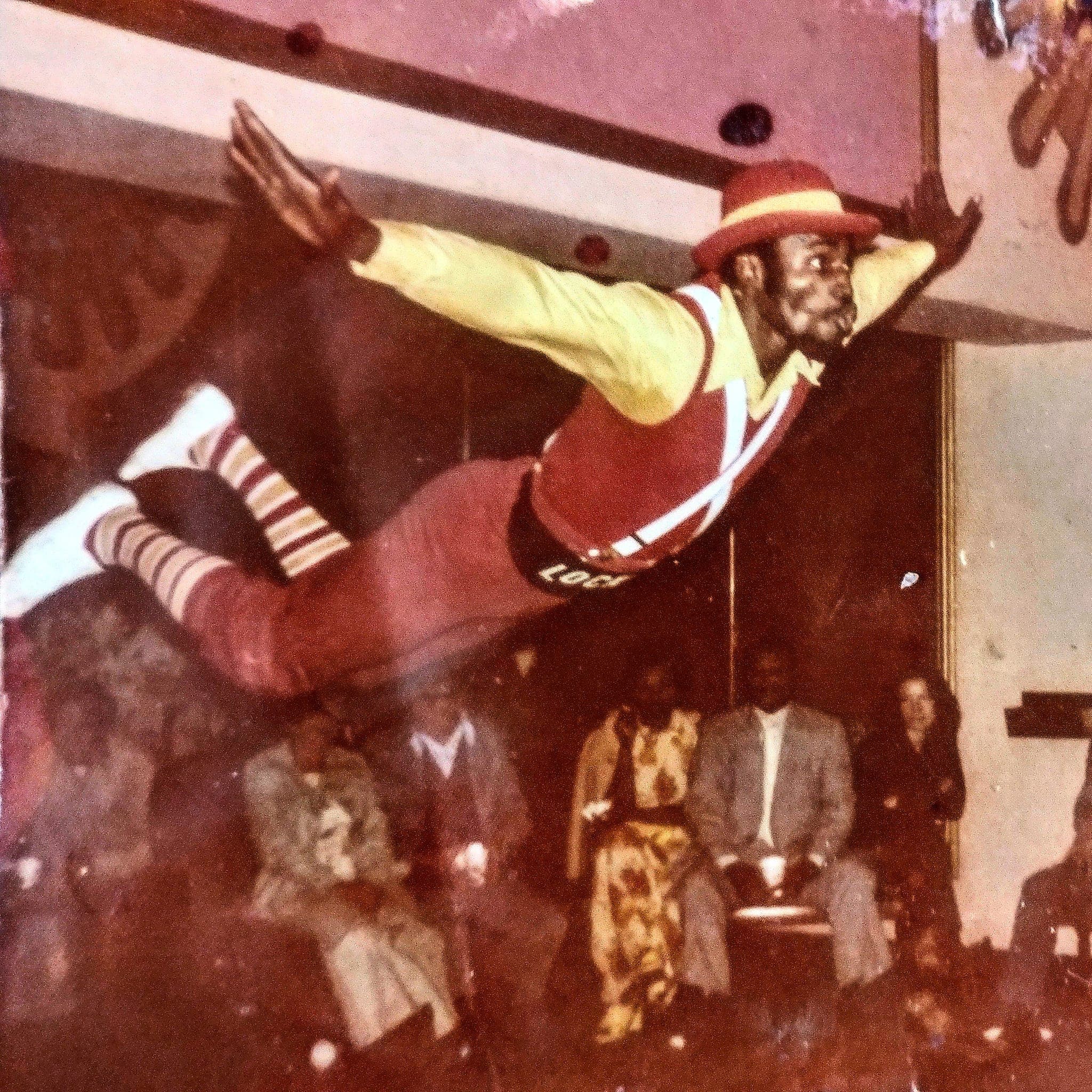
Les half splits étaient déjà exécutés par des chanteurs, danseurs et groupes comme les Nicholas Brothers et le Sammy Davis Jr. Trio. Dans les années 1960 et 1970, James Brown les a rendus populaires. Ses danses et ses pas étaient largement imités lors de fêtes sociales afro-américaines, avec des half splits et des mouvements au sol comme The Alligator. Le Camel Walk et le Mashed Potato furent également repris de son spectacle. Cette influence fut immense. Dans le prolongement des party dances, Don Campbell a continué d’utiliser half splits et knee drops entre ses social dances et ses locks. Il a introduit les kick splits dans le Locking, bien que James Brown, des danseurs de claquettes et des party dancers les aient pratiqués auparavant. High-flying knee drops, running knee drops et Swan Dive ont eux aussi intégré son style.
32
BUTT DROPS
Créé par John « Sambo Lock » McCloud, ce stunt dynamique et audacieux consiste à sauter, tendre les deux pieds devant soi et retomber sur les fesses exactement sur un temps musical.
33
LOCKING HAND SHAKES
Vues pour la première fois chez Damita Jo Freeman et Jimmy « Scooby Doo » Foster pendant un concours de danse de Soul Train. Certaines poignées de main du Locking furent créées par Greg « Campbellock Jr. » Pope et d’abord exécutées par Greg Campbellock Jr. et Fluky Luke — voir la vidéo de Wattstax. Les GoGo Brothers en ont introduit plusieurs autres. Elles représentaient les poignées de main d’unité pratiquées dans les rues des quartiers populaires.
34
THE ROBOT
Bien que le Robot ne soit pas techniquement un lock, le Roboting fait partie du Locking depuis l’amitié entre Don Campbell et Charles « Robot » Washington. Il fut intégré au développement du mouvement comme aux spectacles commerciaux de Locking et lui restera donc toujours lié. Charles « Robot » Washington a introduit le Roboting comme danse et dans la subculture Locking.
35
Your freestyle
You can be free in your own style while remaining within an established dance form such as Locking. In the end, what matters is how you present and represent the dance. Campbellocking was Don Campbell’s freestyle. It inspired what people today call Locking, and many dancers have since contributed steps and ideas to the form. Ultimately, though, the dance also comes down to how you represent yourself.
Words from Don himself
“Nobody can beat you being you.”
Don explains that you can copy or follow someone for a while when you are learning, but eventually something has to come from within yourself.
“Nobody can beat you being you.” If you spend all your time trying to copy somebody else, you will never beat that person at being themselves. You have to keep something of yourself in the dance. Take everything you learn from other people and evolve from it.
When you walk out onto the floor, you should be yourself.
You can learn Don Campbell’s way of doing things, but to truly understand his approach, you also have to understand the freedom behind it. If Don goes left, you do not have to go left — you can go right. Go the way you feel. Hold your arms the way that feels natural to you.
You are still doing the same dance, but you are doing it your way. And that is the beauty of it.
Don then talks about staying humble and gives credit to God for guiding him. He says that in the early days he never asked to become “Don Campbell” or to create something important. When people ask him how he created the dance, he says he does not really know — he felt that his inner voice simply told him to get out there and do what he did, and he was grateful to have been chosen.
Les noms et les attributions peuvent varier selon la tradition orale et les sources proches des participants. Lorsque les éléments disponibles ne suffisent pas, l’attribution reste donc ouverte. Cette liste pourra être enrichie à mesure que de nouvelles informations seront documentées.