Grunden i rörelsen
Locking: steg & rörelser
Lär känna namn, ursprung och berättelser bakom Lockingens steg, rörelser och personliga uttryck.
35 steg och rörelser
Stegen och rörelserna i Campbellocking och Locking uppstod inte som en sluten lista. Don Campbell förde in egna idéer och sådant som redan levde i hans omgivning, och andra pionjärer skapade, förändrade, namngav och kombinerade material när dansen utvecklades.
En del av materialet bygger på gester som människor redan använde – att peka, hälsa eller ge five – och på sociala partydanser. Andra delar har äldre föregångare inom afroamerikansk vernacular jazz dance och tap, till exempel rytmiskt fotarbete, splits, akrobatik och sceniskt uttryck. Dessa former ingår i ett längre afrodiasporiskt sammanhang med kopplingar till traditionella afrikanska danspraktiker. Det betyder inte att varje steg nedan har en enda rak källa; Locking växte fram genom både arv, utbyte, omformning och nya uppfinningar i det afroamerikanska Los Angeles.
01
BASIC LOCK
Basic Lock innebär att armarnas rörelse stannar eller fryser på musikens slag. Don Campbell skapade rörelsen i slutet av 1960-talet eller början av 1970-talet när han stannade upp medan han försökte göra den populära sociala dansen Funky Chicken. Pauserna kom att kallas locks eller locking up.
02
DOUBLE LOCK
Double Lock innebär att man gör två locks direkt efter varandra, vilket skapar en studsande känsla och en tydlig rytmisering. Don Campbell kan ses använda detta sätt att låsa i sina tidiga framträdanden i Soul Train tillsammans med Damita Jo Freeman, där upprepningen både markerar takten och blir en del av hans personliga timing.
03
THE LEO LOCK
Leo ”Fluky Luke” Williamson utvecklade denna karakteristiska lock genom att placera båda händernas utsidor mot midjan och låsa armbågarna framåt. Hans stora rörlighet gav positionen dess tydliga form, och den kom senare även att utföras av andra rörliga lockers.
04
GIVING OR ASKING FOR FIVE
This is a hand slap that acknowledges an agreement either between Two people or oneself while dancing , Don Campbell incorporated this in between his Locks and social dances, The origin of Giving Five or Receiving Five had long been a tradition of acknowledgement in the African American community. This was an established ritual prior to Don incorporating it into his dancing. As people would smile and acknowledge there approval of a move, Don and other pioneers would often offer there hand (to recieve five),accepting a hand slap back was accepting approval. For a move or step. Giving Five is acknowledging something good taking place. Points.
05
LOCKING POINTS
Later refered to as Uncle Sam points, for the U.S. armed forces recruiting poster, which featured the Uncle Sam caricature recruiting by pointing out a message .. Also pointing at a friend or partner was also a message or an acknowledgement in the African American Community, This was also a ritual of communication and was often done when two people had to greet across a distance even prior to it being incorperated, by Don Campbell into his dance style. The story goes , that while Don was dancing, a lady at a table was laughing at his unique style, So Don did what everyone was doing, he pointed at her to let her know that he saw her. and this was the very first and basic Locking point.Later as the dance developed double and triple points were introduced by other pioneers causing a more free flowing rythem to Locking.
06
HAND CLAPS
Back hand claps and Backfront hand claps were also very basic in the beginning , stopping and starting abruptly, they were often done alone while pacing or in-between other moves, Don also incoorperated the very first wristrolls into his style. later various combinations of wrist rolls and other moves were incorporated and done before backfront hand claps, Again this contributed to the continuity and evolution of the dance.
07
UPLOCK
The UPLOCK or what is today refered to as the Muscle man, is the throwing up of both arms usually the start of a locking move, This move was an announcement ,Much like gesture used on the streets as a greeting, saying “Hey” or “whats up on the street”
08
PACE / KEEPING TIME
Pace, även kallad Keeping Time, är en grundläggande taktrörelse som används för att hålla rytmen och binda samman rörelser i Locking. Ena armen slås ut från kroppen åt sidan i takt med musiken. Gesten kan påminna om hur jazzmusiker och publik markerar pulsen; inom Locking kan den också få en mer marscherande eller militärisk karaktär.
09
WRIST TWIRL / WRIST ROLLS
Wrist twirls, även kallade wrist rolls eller rolls, är en grundläggande rörelse inom Locking. Med knutna händer roteras handlederna i en mjuk, rullande rörelse i takt med musiken, som kan avslutas i ett tydligt lock eller stopp. Don Campbell tog in tidiga wrist rolls i sin stil, och senare kombinationer bidrog till att skapa kontinuitet mellan rörelser.
10
THE DON CAMPBELL WALK
This was created by Don Campbell, himself it was sliding stepping movement used by Don to move forward in between Locks and stunts
O.G. Skeeter Rabbits dokument
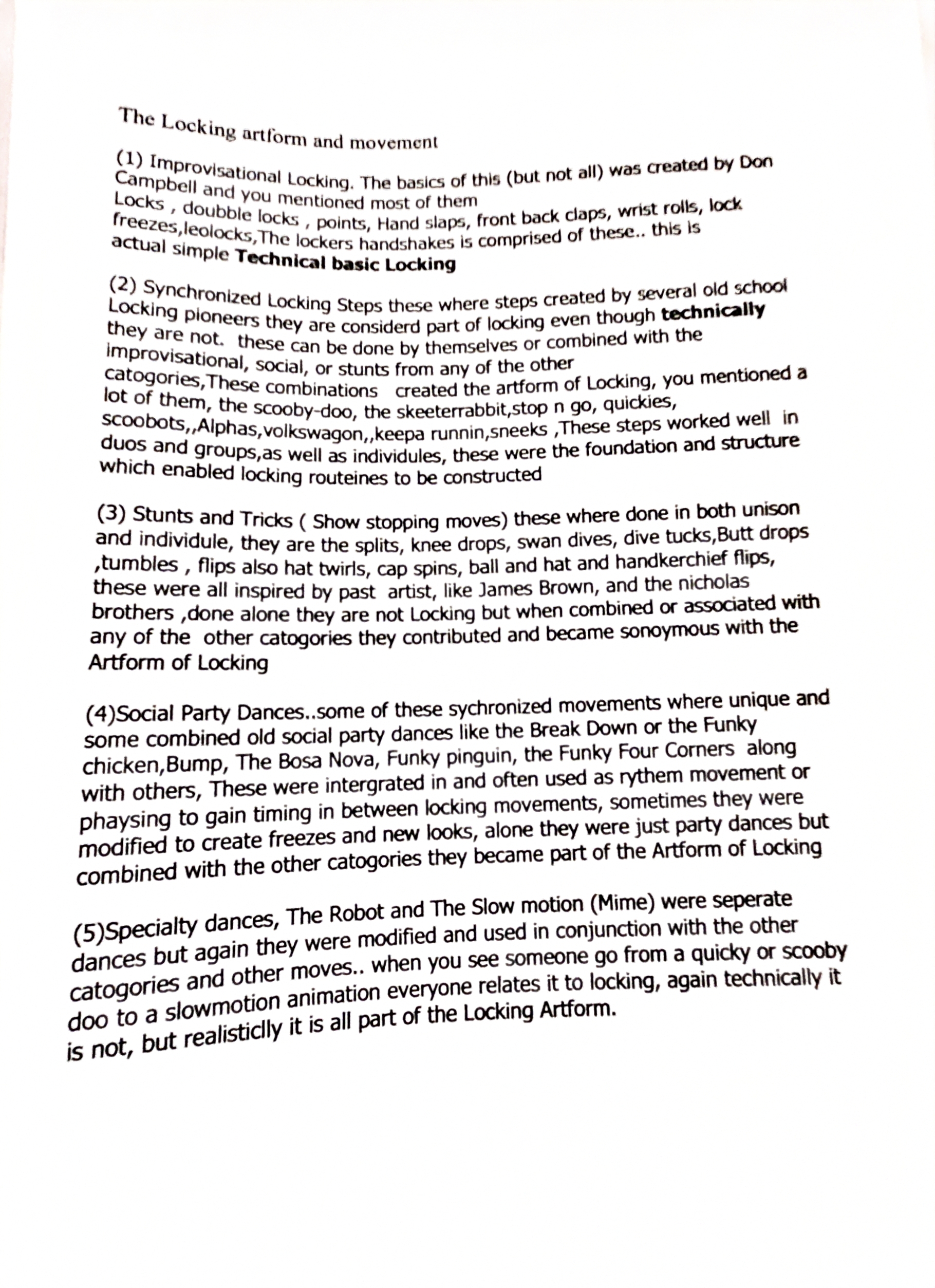
Fem delar som tillsammans formar Locking
O.G. Skeeter Rabbit beskrev fem rörelsefamiljer för att visa hur Locking blev större än en enskild rörelse. Delarna kan existera var för sig, men får en särskild funktion när de kombineras med dansens timing, karaktär och locks.
- 01
Improvisational Locking
Improvisation och teknisk grund
Locks, points, hand slaps, wrist rolls, freezes och andra grundrörelser som kan användas i fri dans.
- 02
Synchronized Locking Steps
Synkroniserade Lockingsteg
Steg utvecklade av flera pionjärer och använda individuellt, i duos och grupper för att bygga rutiner.
- 03
Show-stopping moves
Stunts och tricks
Splits, knee drops, dives, flips och rekvisitatrick som blir del av Locking när de integreras med dansens övriga språk.
- 04
Social Party Dances
Sociala partydanser
Tidens sociala danser ger groove, timing och övergångar mellan Lockingrörelserna och håller kopplingen till dansgolvet levande.
- 05
Specialty dances
Specialiserade danser
Robot, slow motion och mime är egna uttryck som kan vävas in för kontrast, animation och nya kombinationer.
 Öppna originalbild
11
THE SCOOBY DOO
created by Jimmy “Scooby doo “Foster, the basic scooby doo,is two handed up lock anouncement followed by a kick, step
12
THE SCOOBOT
Also by Jimmy “Scooby doo “Foster, the basic scoobot, is a unique step that
13
THE SCOOBY WALK
Jimmy Fosters way of walking, similar to what Greg called the pimpwalk
14
THE PIMP WALK
Created by Greg “Campbellock Jr. “ Pope , many of the move Greg instituted into locking helped promote the free flow and continunity into the style, Greg also modified the scoobot into a hop move, some of the above mentioned moves such as the Sneek & The stop n go (Quickies) where created by Jimmie “Scoobydo” Foster , with impute from Greg Campbellock Jr. and many of these moves were named by Damita Jo Freeman
15
STOP-N-GO / QUICKIE
The Quickie, now more commonly known as Stop-n-Go, became a variation of the older Sara Walk. Its quick movement imitated the rubber-band snap-back of a cartoon character.
16
THE SKEETERRABBIT
created by James “Skeeter Rabbit “Higgins, This step was inspired by the shuffle moves of the nicholas brothers , and the street game of hop scottch, as skeeter added this ending onto the scoobydoo ,it became a continuous movement,that he did various ways. Also variations of skeeterrabbit shuffles added by several other pioneers. The most notable was in the mid 1970s with the blending and acceptance of the street gang culture dance movement with Locking when the streetdance known as the CRIP WALK was first introduced as a finishing move added on to the Skeeterrabbit by Micheal “Peekaboo” Frenke and Leo “Shaboo” Walker
17
HAT TWIRLES
introduced into Locking, Had been done by various entertainers in history. ,The move was adapted by several locking dancers ,the most notables were “Sneeky T” and John “Okey Doke” Wilson” It Later became known as one of Don Campbells signiture moves , but the basic hat spin was first taught to Don in 1974 by SKEETER RABBIT, while on the Lockers first major tour.
18
THE WHICH A WAY
The WhichaWay introduced by Leo “ Flukey Luke “ Williamson into a signature , locking move, However it was originally created as a social party dance step By Damita Jo Freeman who did a modified style of the step by turning her hips in a slower motion than done by Flukey . she originally called this version the “DJ which a way,”she can be seen doing this version on various soul train clips
19
LEO WALK
Leo walk is a side to side stepping and rocking motion
20
KILLING ROACHES / SLAPPING ROACHES / CATCHING ROACHES
A low floor gesture in which the dancer slaps the floor to the rhythm of the music, as if trying to catch or kill a bug. Killing Roaches, Slapping Roaches and Catching Roaches are different names that have been used for the movement. Accounts and terminology differ, so no single creator is credited here.
21
THE SLOW MOTION
introduced in Locking by Fred “ Mr. Penguin “ Berry, the slowmotion was a mime style imitation of locking, where everthing was slowed down and facial expressions was emphisized,
22
THE VOLKSWAGON
the volkswagon was inspired by the driving of an mannual shift car, it imitated shifting and the lunging of a car to the rythem of the music,
23
THE FUNKY GUITAR
A gesture-based movement that imitates playing a guitar to the rhythm of the music. LockerLegends documents it in early Soul Train appearances by Damita Jo Freeman and as part of the dancing she and Don Campbell shared as a couple.
24
THE HITCHHIKE
Imitating hitchhike:in, sideways with a thumbs up and mixing with rocksteady:s funky hip groove
25
SNEEK
The sneek was a variation of the soul dance the breakdown ,but the upper body twisted from side to side swinging the outside arms up in a searching motion, later the inside arm was used by the lockers to allow camera angles during commercial performances.
26
THE HELICOPTOR
The helecopter was Pinguins way of pointing and acknowledging everyone around him in one continuous move
27
THE KEEPA RUNNIN
created by Tony Lewis and Buddy Lombard ( GoGo Bros) the keepa runnin was a footwork, kick step slide move
28
The Sara Walk
the sara walk was a front back pace move,
29
THE SUPER FLY
A Hat move, where you shake your head and reseble a Fly buzzin
30
THE “ALPHA”
The Alpha is a backward-handspring-type floor move created by Alpha Omega Anderson and introduced through his distinctive, fast corkscrew style of Locking. This animated sequence combines a high kick into an Alpha, followed by a split that finishes in a lock pose.
31
STUNTS & SPLITS
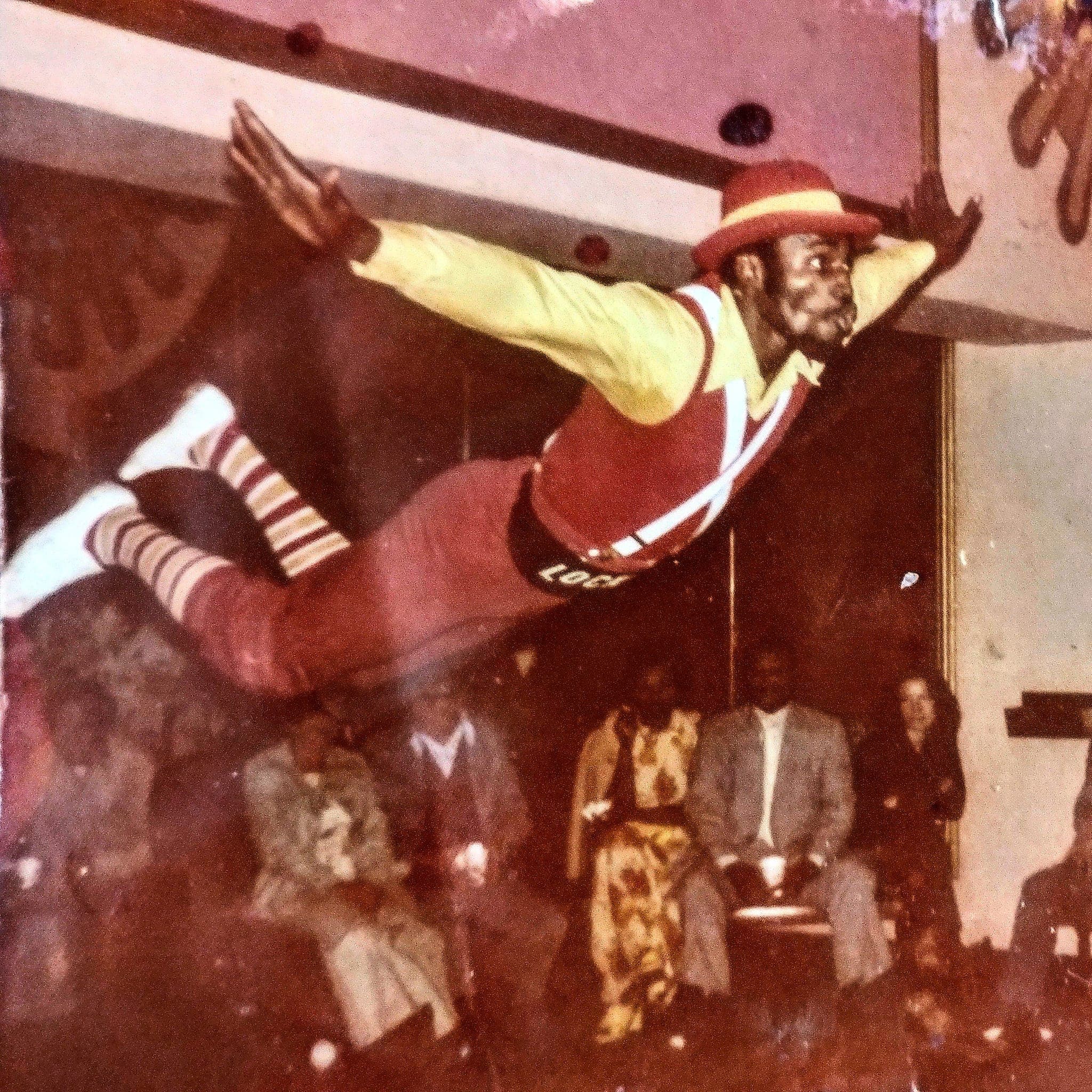
Stunts and tricks within Locking can include the Alpha, splits, knee drops, running knee drops, flips and other show-stopping movements. This animated sequence combines a high kick into an Alpha, followed by a split that finishes in a lock pose. Splits and floor movements already appeared in the work of entertainers such as the Nicholas Brothers and the Sammy Davis Jr. Trio, and James Brown helped popularize the half split during the 1960s and 1970s. Don Campbell incorporated half splits and knee drops between his social dances and locks, and introduced kick splits into Locking, although James Brown, tap dancers and party dancers had performed them earlier.
32
BUTT DROPS
created by John “ Sambo Lock “ McCloud, a dynamic and daring stunt, where the dancer would jump and leve both feet out in front of him , landing on his but in time with a beat in the music
33
LOCKING HAND SHAKES
First seen done by Damita Jo Freeman and Jimmy “Scooby Doo Foster during The soul train Dance contest, Some Locking Handshakes were created by Greg “Campbellock “ Pope , First done by Greg Cambellock Jr and Flukey Luke (see the video Watts Stax.) Several other handshakes were introduced by the ( GoGo Brothers)These hand shakes were representing the unity handshakes done on the streets of the inner city.
34
THE ROBOT
Although technically The Robot is not a Lock, Roboting has always been a part of Locking from the friendship of Don Campbell and Charles “ROBOT” Washington, It was incorporated into both the evolutionary Locking movement and in the commercial Locking Performances.. so it will be forever linked Roboting was introduces as a dance and into the Locking Subculture by Charles “Robot “Washington
35
Your freestyle
Du kan vara fri i din egen stil och samtidigt hålla dig inom en redan etablerad dansform som Locking. I slutändan handlar det om hur du presenterar och representerar dansen. Campbellocking var Don Campbells freestyle. Den inspirerade det som människor i dag kallar Locking, och många dansare har sedan bidragit med steg och idéer till dansformen. Men till sist handlar det också om hur du representerar dig själv.
Words from Don himself
“Nobody can beat you being you.”
Don explains that you can copy or follow someone for a while when you are learning, but eventually something has to come from within yourself.
“Nobody can beat you being you.” If you spend all your time trying to copy somebody else, you will never beat that person at being themselves. You have to keep something of yourself in the dance. Take everything you learn from other people and evolve from it.
When you walk out onto the floor, you should be yourself.
You can learn Don Campbell’s way of doing things, but to truly understand his approach, you also have to understand the freedom behind it. If Don goes left, you do not have to go left — you can go right. Go the way you feel. Hold your arms the way that feels natural to you.
You are still doing the same dance, but you are doing it your way. And that is the beauty of it.
Don then talks about staying humble and gives credit to God for guiding him. He says that in the early days he never asked to become “Don Campbell” or to create something important. When people ask him how he created the dance, he says he does not really know — he felt that his inner voice simply told him to get out there and do what he did, and he was grateful to have been chosen.
Benämningar och upphovsuppgifter kan skilja sig mellan den muntliga traditionen och olika deltagarnära källor. Därför lämnas upphov öppet när underlaget inte räcker. Listan kan byggas ut när fler uppgifter kan beläggas.