
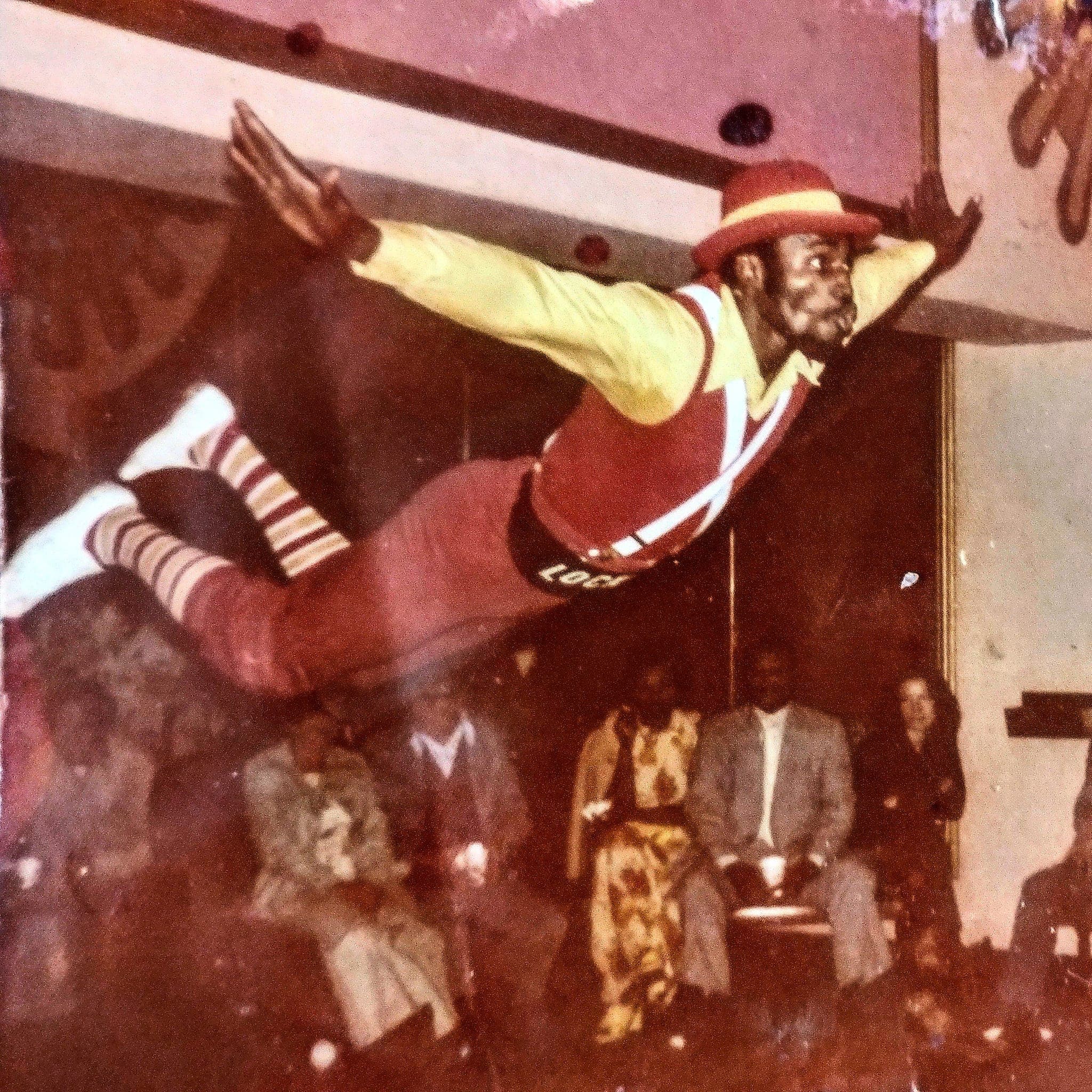
LOCKINGCAMPBELLOCKING

动作中的基础

步法与动作

探索塑造 Locking 的动作名称、来源与背后的故事。

35 动作与步法

Campbellocking 与 Locking 的动作和步法,并不是从一开始就以一份固定清单存在。Don Campbell 把自己的想法与周围已经存在的动作带进舞蹈;随着舞蹈发展,其他先驱又创造、改变、命名并组合了新的动作。

有些动作与日常手势和社交派对舞蹈有关,例如指向别人、打招呼或击掌。富有节奏的 footwork、splits、杂技和 showmanship 等元素,在美国非裔 vernacular jazz dance 与 tap dance 中有更早的先例,而这些形式本身又处于更长的 African diaspora 文化脉络之中,并与传统非洲舞蹈文化存在联系。这并不意味着下面每一个动作都有单一、直接的来源。Locking 是在美国非裔 Los Angeles 社群中,通过继承、交流、变化与新的创造逐渐成长起来的。

01

BASIC LOCK

Basic Lock 是一种随着音乐节拍让手臂动作突然停住、像冻结一样定格的动作。1960年代末至1970年代初,Don Campbell 在尝试当时流行的社交舞 Funky Chicken 时,形成了这种瞬间停顿、像卡住一样的动作。这些停顿后来被称为 locks 或 locking up。

Step in motion

BASIC LOCK

The hesitating or Freezing of the Arms to the beats of the music, where created By Don Campbell the Late 1960s, early 1970s as he paused or froze while trying to do a popular social dance called the 'funky chicken' between doing this and various other social dances and stunts.The pauses became known as locks or locking up.

AI-generated visual interpretation. Movements can vary between dancers and traditions.

02

DOUBLE LOCK

Double Lock 是连续做两次 lock,通过重复形成带有 bounce 的感觉和鲜明的节奏重音。在 Don Campbell 与 Damita Jo Freeman 早期登上 Soul Train 的影像中,可以看到他使用这种方式;重复 lock 既能标记节拍,也构成了他个人 timing 的一部分。

Step in motion

DOUBLE LOCK

The Double Lock repeats the lock twice in direct succession, creating a bouncing, rhythmically accented feeling. Don Campbell can be seen using this approach in his early Soul Train appearances with Damita Jo Freeman, where repeating the lock became both a way to mark the beat and part of his personal timing.

AI-generated visual interpretation. Movements can vary between dancers and traditions.

03

THE LEO LOCK

Leo “Fluky Luke” Williamson 发展了这个独特的 lock:把双手外侧放在腰间,同时让双肘向前锁住。他出色的柔韧性让这个姿势呈现出鲜明的造型,后来其他柔韧性较强的 locker 也开始使用它。

04

GIVING OR ASKING FOR FIVE

这是一种在跳舞过程中表达两个人之间认同、共鸣或鼓励的 hand slap。Don Campbell 会把这种动作放在 locks 和社交舞之间。Give Five 在 Don 把它带入舞蹈之前很久,就已经是美国非裔社区中表达认可与共鸣的传统手势。当人们看到一个精彩动作并笑着回应时,Don 和其他先驱有时会伸出手接受 five;掌心相碰,就是对这种认可的回应。Giving Five 本质上是一种共同确认“刚才发生了好事”的 gesture。

Step in motion

GIVING OR ASKING FOR FIVE

This is a hand slap that acknowledges an agreement either between Two people or oneself while dancing , Don Campbell incorporated this in between his Locks and social dances, The origin of Giving Five or Receiving Five had long been a tradition of acknowledgement in the African American community. This was an established ritual prior to Don incorporating it into his dancing. As people would smile and acknowledge there approval of a move, Don and other pioneers would often offer there hand (to recieve five),accepting a hand slap back was accepting approval. For a move or step. Giving Five is acknowledging something good taking place. Points.

AI-generated visual interpretation. Movements can vary between dancers and traditions.

05

LOCKING POINTS

后来也被称为 Uncle Sam points,这个名称让人联想到美国征兵海报中 Uncle Sam 指向观看者的形象。在美国非裔社区里,用手指向朋友或舞伴本来就是传递信息与认可的 gesture,也可用于向远处的人打招呼;它在 Don Campbell 把它纳入舞蹈之前已经存在。流传的故事是:Don 跳舞时,桌旁一位女性看到他独特的风格后笑了,于是 Don 像人们平常那样指向她,表达“我看到你了”的意思,这被认为是早期 Locking point 的来源之一。之后其他先驱加入 double、triple points,让 Locking 的动作连接更加流畅。

Step in motion

LOCKING POINTS

Later refered to as Uncle Sam points, for the U.S. armed forces recruiting poster, which featured the Uncle Sam caricature recruiting by pointing out a message .. Also pointing at a friend or partner was also a message or an acknowledgement in the African American Community, This was also a ritual of communication and was often done when two people had to greet across a distance even prior to it being incorperated, by Don Campbell into his dance style. The story goes , that while Don was dancing, a lady at a table was laughing at his unique style, So Don did what everyone was doing, he pointed at her to let her know that he saw her. and this was the very first and basic Locking point.Later as the dance developed double and triple points were introduced by other pioneers causing a more free flowing rythem to Locking.

AI-generated visual interpretation. Movements can vary between dancers and traditions.

06

HAND CLAPS

Back hand claps 与 back-front hand claps 是早期 Locking 非常基础的元素。它们可以作为突然停住再重新开始的方式,单独用于 pacing,也经常放在不同动作之间。Don 也把早期 wrist rolls 纳入自己的风格。后来,wrist rolls 与其他动作的不同组合被放在 back-front hand claps 前面,进一步帮助舞蹈形成连续性并继续发展。

07

UPLOCK

UPLOCK,如今也常被称为 Muscle Man,通常在开始一组 Locking 动作时把双臂向上抛起。它带有一种 announcement 的感觉,就像街头用“Hey”或“What’s up?”打招呼一样,明确告诉周围的人:我在这里。

Step in motion

UPLOCK

The UPLOCK or what is today refered to as the Muscle man, is the throwing up of both arms usually the start of a locking move, This move was an announcement ,Much like gesture used on the streets as a greeting, saying “Hey” or “whats up on the street”

AI-generated visual interpretation. Movements can vary between dancers and traditions.

08

PACE / KEEPING TIME

Pace,也称 Keeping Time,是一种用于保持节奏并衔接 Locking 动作的基础律动。随着音乐的拍点,将一只手臂从身体向侧面打出。这个手势可能让人联想到爵士乐手和观众标记节拍的方式;在 Locking 中,它也可以呈现出更接近行进或军队式动作的感觉。

Step in motion

PACE / KEEPING TIME

Pace, also called Keeping Time, is a foundational timing movement used to stay with the rhythm and connect Locking moves. One arm is sent out from the body to the side in time with the music. The gesture may recall the way jazz musicians and listeners mark the pulse; within Locking it can also take on a more marching or military character.

AI-generated visual interpretation. Movements can vary between dancers and traditions.

09

WRIST TWIRL / WRIST ROLLS

Wrist twirl,也称 wrist roll 或 roll,是 Locking 的基础动作之一。双手握起,手腕随着音乐以流畅的滚动方式旋转,并可以用清晰的 lock 或停顿收尾。Don Campbell 将早期的 wrist rolls 融入自己的风格,后来的组合也帮助动作之间形成连续性。

Step in motion

WRIST TWIRL / WRIST ROLLS

Wrist twirls, also called wrist rolls or rolls, are a foundational movement in Locking. With the hands closed, the wrists rotate in a smooth rolling action to the music and can resolve in a distinct lock or stop. Don Campbell incorporated early wrist rolls into his style, and later combinations helped create continuity between movements.

AI-generated visual interpretation. Movements can vary between dancers and traditions.

10

THE DON CAMPBELL WALK

Don Campbell 创造的一种 sliding step 移动动作,用于在 locks 与 stunts 之间向前移动。

Step in motion

THE DON CAMPBELL WALK

This was created by Don Campbell, himself it was sliding stepping movement used by Don to move forward in between Locks and stunts

AI-generated visual interpretation. Movements can vary between dancers and traditions.

来自 O.G. Skeeter Rabbit 的资料

构成 Locking 的五类元素

O.G. Skeeter Rabbit 用五类动作家族来说明:Locking 远远不只是一个动作。每一类都可以独立存在,但当它们与 Locking 的 timing、character 和 locks 结合时,就会发挥特别的作用。

  1. 01

    Improvisational Locking

    即兴与技术基础

    自由舞中使用的 locks、points、hand slaps、wrist rolls、freezes 以及其他基础动作。

  2. 02

    Synchronized Locking Steps

    同步 Locking 步法

    由多位先驱发展出的步法,可用于 solo、duo 或 group 编排 routine。

  3. 03

    Show-stopping moves

    特技与技巧动作

    包括 splits、knee drops、dives、flips 和使用道具的 tricks。与 Locking 的其他语言结合后,它们成为舞蹈的一部分。

  4. 04

    Social Party Dances

    社交派对舞蹈

    当时的社交舞让 Locking 的动作之间保持 groove、timing 与 transition,也让舞者与舞池文化的联系始终鲜活。

  5. 05

    Specialty dances

    特殊舞蹈形式

    Robot、slow motion 和 mime 都是可以独立存在的形式;把它们编织进 Locking 后,可以制造对比、动画感与新的组合。
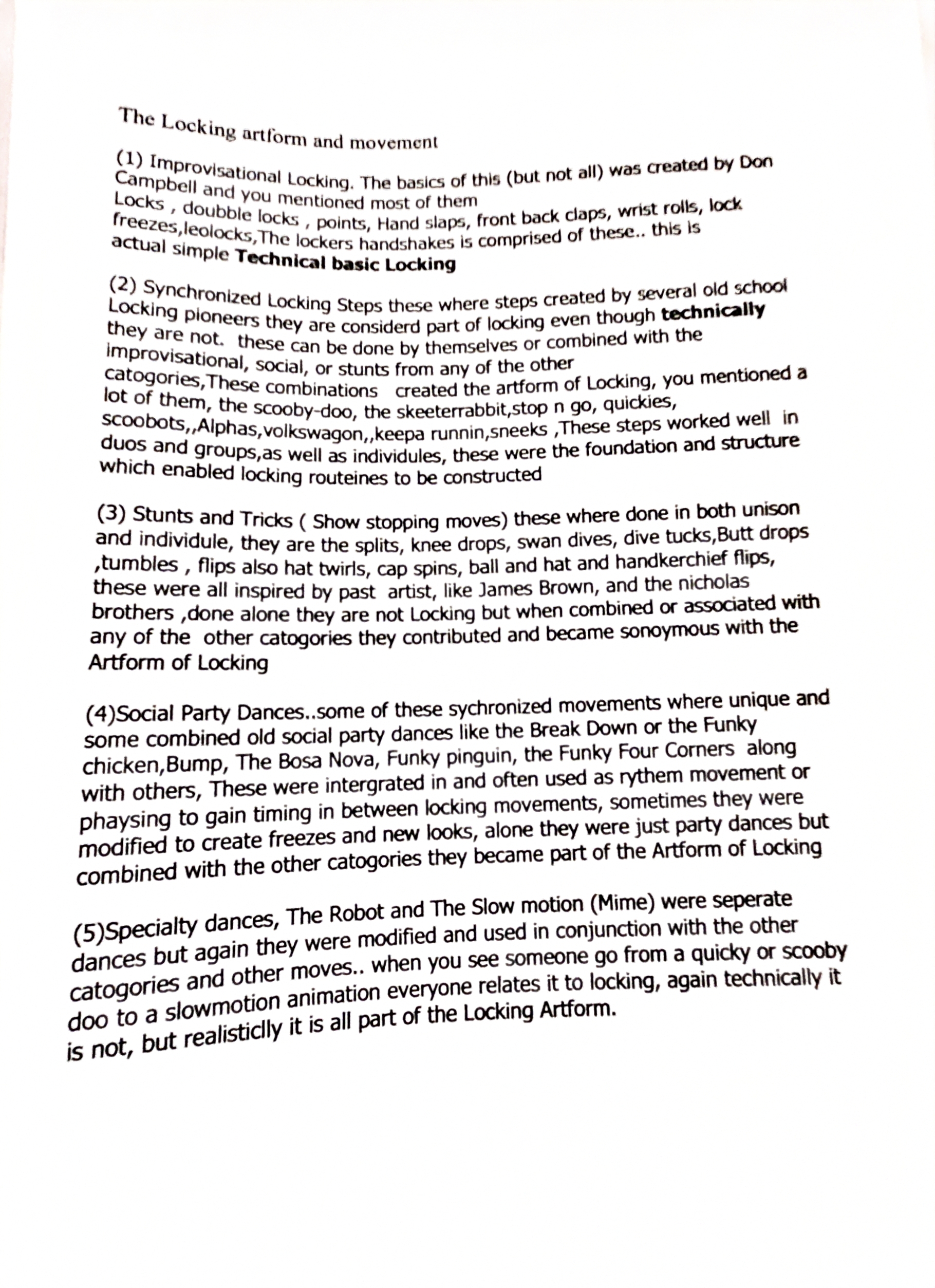
O.G. Skeeter Rabbit 的资料“The Locking artform and movement”打开原图
保存并通过 Locking.se 分享的 O.G. Skeeter Rabbit 原始资料。

11

THE SCOOBY DOO

由 Jimmy “Scooby Doo” Foster 创造。基本 Scooby Doo 从双手做 uplock announcement 开始,然后连接 kick 与 step。

Step in motion

THE SCOOBY DOO

created by Jimmy “Scooby doo “Foster, the basic scooby doo,is two handed up lock anouncement followed by a kick, step

AI-generated visual interpretation. Movements can vary between dancers and traditions.

12

THE SCOOBOT

同样是 Jimmy “Scooby Doo” Foster 创造的独特舞步。

Step in motion

THE SCOOBOT

Also by Jimmy “Scooby doo “Foster, the basic scoobot, is a unique step that

AI-generated visual interpretation. Movements can vary between dancers and traditions.

13

THE SCOOBY WALK

Jimmy Foster 特有的一种走法,与 Greg 所称的 Pimp Walk 有相似之处。

Step in motion

THE SCOOBY WALK

Jimmy Fosters way of walking, similar to what Greg called the pimpwalk

AI-generated visual interpretation. Movements can vary between dancers and traditions.

14

THE PIMP WALK

由 Greg “Campbellock Jr.” Pope 创造。Greg 为 Locking 加入的多种动作,帮助这门舞蹈形成更自由、连续的 flow。他也会把 Scoobot 变化成 hop 型动作。上文提到的 Sneek、Stop N Go(Quickies)等动作,则由 Jimmy “Scooby Doo” Foster 在 Greg Campbellock Jr. 的想法影响下发展;许多动作名称是由 Damita Jo Freeman 命名。

15

QUICKIES /STOP N GO

Quickies,也叫 Stop N Go,是在旧 Sara Walk 动作基础上变化发展出来的。快速弹回的感觉让人联想到像橡胶一样跳起的卡通角色。

Step in motion

STOP-N-GO / QUICKIE

The Quickie, now more commonly known as Stop-n-Go, became a variation of the older Sara Walk. Its quick movement imitated the rubber-band snap-back of a cartoon character.

AI-generated visual interpretation. Movements can vary between dancers and traditions.

16

THE SKEETERRABBIT

由 James “Skeeter Rabbit” Higgins 创造。动作受到 Nicholas Brothers 的 shuffle,以及街头游戏 hopscotch 的启发。Skeeter 把这个动作接在 Scooby Doo 结尾后,使它成为连续的组合,并进一步发展出多种形式。其他先驱后来也创造了 Skeeter Rabbit shuffle 的变化。到1970年代中期,街头 gang culture 的某些 dance move 也开始与 Locking 混合;例如 Crip Walk 有时会被放在 Skeeter Rabbit 结尾,Michael “Peekaboo” Frenke 与 Leo “Shaboo” Walker 常在这条发展脉络中被提到。

Step in motion

THE SKEETERRABBIT

created by James “Skeeter Rabbit “Higgins, This step was inspired by the shuffle moves of the nicholas brothers , and the street game of hop scottch, as skeeter added this ending onto the scoobydoo ,it became a continuous movement,that he did various ways. Also variations of skeeterrabbit shuffles added by several other pioneers. The most notable was in the mid 1970s with the blending and acceptance of the street gang culture dance movement with Locking when the streetdance known as the CRIP WALK was first introduced as a finishing move added on to the Skeeterrabbit by Micheal “Peekaboo” Frenke and Leo “Shaboo” Walker

AI-generated visual interpretation. Movements can vary between dancers and traditions.

17

HAT TWIRLES

Hat twirls 在进入 Locking 之前就已经被许多表演者使用。多位 Locking 舞者把它吸收进自己的风格,其中“Sneaky T”和 John “Okie Doke” Wilson 尤其以帽子动作闻名。后来它成为 Don Campbell 的代表性 signature 之一,不过记录称,基本 hat spin 是1974年 The Lockers 第一次大型巡演期间,由 Skeeter Rabbit 教给 Don 的。

18

THE WHICH A WAY

Leo “Fluky Luke” Williamson 把 Which-A-Way 发展成 Locking 的 signature move。不过它最初来自 Damita Jo Freeman 创造的社交派对舞步;她的版本速度更慢,并加入更明显的腰部旋转。她把自己的版本称为“DJ Which-A-Way”,在多段 Soul Train 影像中可以看到。

Step in motion

THE WHICH A WAY

The WhichaWay introduced by Leo “ Flukey Luke “ Williamson into a signature , locking move, However it was originally created as a social party dance step By Damita Jo Freeman who did a modified style of the step by turning her hips in a slower motion than done by Flukey . she originally called this version the “DJ which a way,”she can be seen doing this version on various soul train clips

AI-generated visual interpretation. Movements can vary between dancers and traditions.

19

LEO WALK

Leo Walk 是一种左右踏步并保持 rocking 感的移动动作。

Step in motion

LEO WALK

Leo walk is a side to side stepping and rocking motion

AI-generated visual interpretation. Movements can vary between dancers and traditions.

20

KILLING ROACHES / SLAPPING ROACHES / CATCHING ROACHES

一种靠近地面进行的 gesture:舞者随着音乐节奏用手拍地,表现得像在抓或拍死虫子。历史上曾使用 Killing Roaches、Slapping Roaches、Catching Roaches 等多个名称。由于不同记录与术语并不完全一致,这里不把它归功于单一创作者。

21

THE SLOW MOTION

由 Fred “Mr. Penguin” Berry 带入 Locking。Slow Motion 是受 mime 影响的 Locking 表达方式,把所有动作放慢,并强化面部表情。

22

THE VOLKSWAGON

Volkswagon 是受手动挡汽车驾驶启发的动作。舞者模仿换挡以及汽车向前顿挫的感觉,并把它准确放进音乐节奏中。

23

THE FUNKY GUITAR

一种随着音乐节奏模仿弹吉他的 gesture-based move。LockerLegends 在 Damita Jo Freeman 早期 Soul Train 出演,以及她与 Don Campbell 双人共舞的影像中记录到了这个动作。

24

THE HITCHHIKE

模仿搭便车动作的舞步。舞者保持拇指竖起并向侧面移动,同时结合 Rocksteady 式的 funky hip groove。

25

SNEEK

Sneek 是 Soul dance Breakdown 的一种变形。舞者左右扭转上半身,同时抬起外侧手臂,做出像是在寻找什么的 gesture。之后 The Lockers 为了让商业舞台上的摄影角度更容易看清动作,又发展出使用内侧手臂的版本。

26

THE HELICOPTOR

The Helicopter 是 Mr. Penguin 用一个连续动作依次指向、认可并向周围所有人打招呼的方式。

27

THE KEEPA RUNNIN

由 GoGo Brothers 的 Tony Lewis 与 Buddy Lombard 创造。Keepa Runnin 是把 kick、step 与 slide 结合起来的 footwork move。

28

The Sara Walk

Sara Walk 是一种在前后 pacing 的同时进行移动的动作。

29

THE SUPER FLY

一个使用帽子的动作:舞者摇动头部,模仿一只嗡嗡飞动的苍蝇。

30

THE “ALPHA”

由 Alpha Omega Anderson 创造并加入个人 Locking 风格,是一种向后倒下、类似 handspring 的地板动作。他的风格中也包括快速旋转、corkscrew style 的 Locking move。

Step in motion

THE “ALPHA”

The Alpha is a backward-handspring-type floor move created by Alpha Omega Anderson and introduced through his distinctive, fast corkscrew style of Locking. This animated sequence combines a high kick into an Alpha, followed by a split that finishes in a lock pose.

AI-generated visual interpretation. Movements can vary between dancers and traditions.

31

STUNTS & SPLITS

在 Locking 出现之前,Nicholas Brothers、Sammy Davis Jr. Trio 等歌手、舞者和团体就已经在表演中使用 half splits。1960—70年代,James Brown 极大地把 half split 推向大众。他的舞台舞蹈与舞步在美国非裔社交派对中被广泛模仿,其中包括 half splits、The Alligator 等地板动作;Camel Walk、Mashed Potato 等动作也因他的表演而被更多人吸收,影响非常巨大。Don Campbell 同样在派对舞蹈语境中,经常把 half splits 与 knee drops 放在社交舞与 locks 之间。Kick splits 是由 Don Campbell 带入 Locking 的,但此前 James Brown、tap dancer 与 party dancer 就已经使用。High-flying knee drops、running knee drops 与 Swan Dive 也成为 Don 个人风格的一部分。

Step in motion

STUNTS & SPLITS

Stunts and tricks within Locking can include the Alpha, splits, knee drops, running knee drops, flips and other show-stopping movements. This animated sequence combines a high kick into an Alpha, followed by a split that finishes in a lock pose. Splits and floor movements already appeared in the work of entertainers such as the Nicholas Brothers and the Sammy Davis Jr. Trio, and James Brown helped popularize the half split during the 1960s and 1970s. Don Campbell incorporated half splits and knee drops between his social dances and locks, and introduced kick splits into Locking, although James Brown, tap dancers and party dancers had performed them earlier.

AI-generated visual interpretation. Movements can vary between dancers and traditions.

32

BUTT DROPS

由 John “Sambo Lock” McCloud 创造,是一种大胆而富有冲击力的 stunt。舞者跳起后把双腿向前伸直,并准确踩着音乐节拍以臀部落地。

33

LOCKING HAND SHAKES

Damita Jo Freeman 与 Jimmy “Scooby Doo” Foster 在 Soul Train Dance Contest 中一起完成的动作,是较早被记录下来的例子之一。部分 Locking handshakes 由 Greg “Campbellock Jr.” Pope 创造,据传 Greg Campbellock Jr. 与 Fluky Luke 是最早展示其中一些版本的人(参见 Wattstax 影像)。GoGo Brothers 也发展并使用了多个不同 handshake。这些动作反映了城市街头用于表达 unity 的 handshakes。

34

THE ROBOT

严格来说,Robot 本身并不是一个 lock,但通过 Don Campbell 与 Charles “Robot” Washington 的关系,Roboting 长期与 Locking 的历史交织在一起。它既出现在 Locking 的发展过程中,也出现在商业化 Locking 表演里,因此两种形式一直保持联系。Charles “Robot” Washington 被记录为把 Robot 作为独立舞蹈、同时也把它带入 Locking 亚文化的重要人物。

Step in motion

THE ROBOT

Although technically The Robot is not a Lock, Roboting has always been a part of Locking from the friendship of Don Campbell and Charles “ROBOT” Washington, It was incorporated into both the evolutionary Locking movement and in the commercial Locking Performances.. so it will be forever linked Roboting was introduces as a dance and into the Locking Subculture by Charles “Robot “Washington

AI-generated visual interpretation. Movements can vary between dancers and traditions.

35

Your freestyle

You can be free in your own style while remaining within an established dance form such as Locking. In the end, what matters is how you present and represent the dance. Campbellocking was Don Campbell’s freestyle. It inspired what people today call Locking, and many dancers have since contributed steps and ideas to the form. Ultimately, though, the dance also comes down to how you represent yourself.

Words from Don himself

“Nobody can beat you being you.”

Don explains that you can copy or follow someone for a while when you are learning, but eventually something has to come from within yourself.

“Nobody can beat you being you.” If you spend all your time trying to copy somebody else, you will never beat that person at being themselves. You have to keep something of yourself in the dance. Take everything you learn from other people and evolve from it.

When you walk out onto the floor, you should be yourself.

You can learn Don Campbell’s way of doing things, but to truly understand his approach, you also have to understand the freedom behind it. If Don goes left, you do not have to go left — you can go right. Go the way you feel. Hold your arms the way that feels natural to you.

You are still doing the same dance, but you are doing it your way. And that is the beauty of it.

Don then talks about staying humble and gives credit to God for guiding him. He says that in the early days he never asked to become “Don Campbell” or to create something important. When people ask him how he created the dance, he says he does not really know — he felt that his inner voice simply told him to get out there and do what he did, and he was grateful to have been chosen.

Rob — Locking freestyle

由于口述传统和以亲历者为中心的资料并不总是完全一致,动作名称及创作者的说法可能不同。证据不足时,我们不会武断地下定论。随着更多内容得到资料验证,这份列表也会继续扩展。

资料来源与延伸阅读