
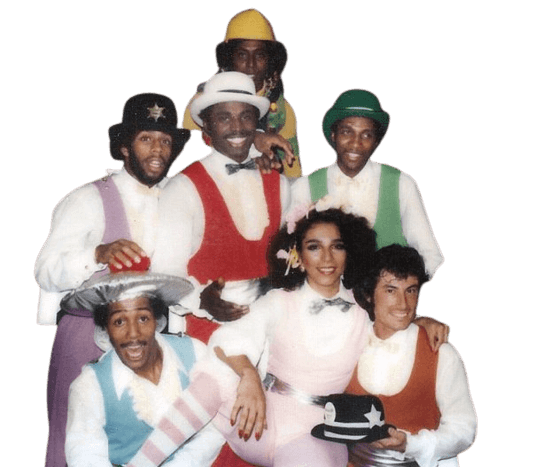
A culture in motion
Timeline of Locking
A chronological entry point to important moments, groups and changes.
Source map / 1970–2007
A map of people, places and transmission
This timeline is an editorial adaptation of the Locking History Chart, credited to Steven Notario in the PDF metadata. The chart does more than arrange dates: it traces how the dance moved through clubs, television productions, workshops, ensembles and personal encounters.
For readability, its many arrows have been organized into three periods. Events are grounded in the chart’s dates and labels, while the wording has been carefully summarized and placed in its African American Los Angeles context. The final section supplements the chart with clearly sourced events and first-hand perspectives on international transmission.
1970-1972
From the Campbellock to a growing scene
The opening years connect Don Campbell’s personal expression with the clubs, dancers and African American cultural spaces in which Locking became a shared movement.
- Key event
The Campbellock takes shape
The chart places the beginning at Trade Tech College. Don Campbell stops while attempting the social dances of the time and is encouraged to repeat the unusual pause. The movement is called “the Lock”, and his improvised style becomes the basis of Campbellocking.
Names in the chart
- Don Campbell
- Sam Washington
- Elroy Skifford
- Key event
The first dancers learn at The Citadel
Don meets other dancers at contests several nights a week. They exchange new steps and develop quick locks, points, hand slaps and splits. The chart names 22 early dancers and marks several as creators of steps that remain in use.
Names in the chart
- Arnetta Johnson
- Damita Jo Freeman
- Charles “Robot” Washington
- Fred “Mr. Penguin” Berry
- Greg “Campbellock Jr.” Pope
- Jimmy “Scooby-Doo” Foster
The scene grows across more clubs
As the underground dance scene expands, more dancers travel between clubs to meet and learn. The chart’s second group shows knowledge spreading beyond the circle that would later become most visible in the media.
Names in the chart
- Alpha “Omega” Anderson
- Greg “Captain Crunch” Daindridge
- Haywood “Tito” Collins
- John “Okie Doke” Wilson
- Pat “Madam Butterfly” Davis
Go Go and Yo Yo Brothers organize and teach
The Go Go Brothers and Yo Yo Brothers perform at schools and community events, teach Locking and develop unison choreography. The chart describes them as the first groups organized around this transmission.
Names in the chart
- James “Skeeter Rabbit” Higgins
- Edwin “Buddy Go Go” Lombard
- Kevin “Yo Yo” Higgins
- Tony “Go Go” Lewis
- Jimmy “Scooby-Doo” Foster
- Key event
Soul Train begins taping in Los Angeles
When Soul Train moves production to Los Angeles, Don Campbell invites friends from venues including The Summit on the Hill, The Citadel, Maverick’s Flat and Blueberry Hill. Locking gains recurring national television visibility, and a wider Soul Train circle takes shape.
Watts Writers Workshop and Creative Generation
Dancers are invited to teach at the Watts Writers Workshop and encounter writing, choreography, dance, music, lighting and stagecraft. Creative Generation forms there, bringing solo and unison choreography into one group according to the chart.
Names in the chart
- Edwin “Buddy Go Go” Lombard
- James “Skeeter Rabbit” Higgins
- Jimmy “Scooby-Doo” Foster
- Arnetta Johnson
- Shelly Cepeda
- Lorna Dune
- Key event
Touring, Soul Train and Wattstax
The Soul Train Gang tours in June. On August 20, Wattstax provides another major public stage for Campbellocking/Locking. The chart locates the dance squarely within the musical and cultural movement of 1972.
- Key event
The Campbellockers begin booking as a group
Don Campbell’s manager Sonny Craver books The Campbellockers, still presented as powerful solo dancers rather than a routine-based ensemble. During this period Don meets Toni Basil at The Citadel; the chart describes how she later becomes manager, develops performance opportunities and helps shape the group named The Lockers.
Names in the chart
- Don Campbell
- Johnnie “Sambo-Lock” McCloud
- Bill “Slim the Robot” Williams
- Charles “Robot” Washington
- Fred “Mr. Penguin” Berry
- Toni Basil
1973-1979
Groups, contests and direct lines of learning
The second part of the chart branches outward. The Lockers are a central line, but several ensembles, teachers and scenes develop at the same time.
- Key event
The Orange County encounter
A dance contest at Cal State Fullerton creates contact between African American pioneers from South Central Los Angeles and dancers in Orange County. The chart emphasizes personal exchange and direct teaching in the dance’s movement across geographic and social boundaries.
Names in the chart
- James “Skeeter Rabbit” Higgins
- Edwin “Buddy Go Go” Lombard
- Kevin “Yo Yo” Higgins
- Tony “Go Go” Lewis
- Leo “Fluky Luke” Williamson
- Greg “Campbellock Jr.” Pope
The Lockers with Toni Basil
The chart labels this branch February 1973-1977. The Lockers’ document-based history specifies that the group’s foundation was formed for the June 19, 1973 Roberta Flack special, that the name officially changed to The Lockers on October 23, and that the seven original members performed together under that name on November 23. The group combines distinct individual characters with choreography and develops a wide-ranging stage and television career.
Names in the chart
- Don Campbell
- Greg “Campbellock Jr.” Pope
- Leo “Fluky Luke” Williamson
- Adolfo “Shabba-Doo” Quiñones
- Fred “Mr. Penguin” Berry
- Bill “Slim the Robot” Williams
- Toni Basil
New professional ensembles branch from the scene
Jeff Kutash’s production line is connected in the chart with The Greasy Kids and Dancin Machine A, B and C. The Funky Bunch grows around The Citadel and Grand Hotel. These branches show Locking moving between club, teaching and professional stage.
Names in the chart
- Jeff Kutash
- Tony “Crackerjack” Pierce
- Steve “Sugarfoot” Notario
- Vince “Sherlock” Harper
- Steve “Shooka Boo” Wallace
- Nanette “No No” Martin
The Ghetto Dancers and The Lockers teach The Funky Bunch
The chart documents several named teacher-student relationships between pioneers and members of The Funky Bunch. Embodied, person-to-person transmission - who actually taught whom - becomes central to this part of the timeline.
Names in the chart
- James “Skeeter Rabbit” Higgins
- Greg “Campbellock Jr.” Pope
- Greg “Captain Crunch” Daindridge
- Don Campbell
- Jimmy “Scooby-Doo” Foster
Something Special tours Japan
Something Special carries Locking through international performances. The chart especially identifies Jimmy “Scooby-Doo” Foster and Pat “Madam Butterfly” Davis, linking this touring branch to later developments in Japan.
Names in the chart
- Jimmy “Scooby-Doo” Foster
- Pat “Madam Butterfly” Davis
- Eddie Cole
- Wanda Fuller
1976-2007
Continuing lines and international transmission
The later boxes trace groups that carry the dance forward in the United States and people who teach beyond it. Dates overlap because several lines continue in parallel.
Las Vegas Lockers
Las Vegas Lockers becomes a long-running performance branch. The chart links the group to the Dancin Machine line and to dancers who continue through several other ensembles.
Names in the chart
- Frank “Sundance” Sams
- Robbie “Smokey Jr.” LaBlanc
- Robert “Shoebox” Huffman
- Martin “Ric-O-Shay Rabbit” Mancuso
Dance Class gathers more performers
The briefly dated Dance Class branch brings together dancers from several other chart lines. It illustrates the continuing overlap between teaching and new ensembles.
Names in the chart
- Nanette “No No” Martin
- Steve “Sugarfoot” Notario
- Adolfo “Shabba-Doo” Quiñones
- Anna “Lollipop” Sanchez
- Dallas Winkler
Multiple groups carry the form forward
Locking, The Ecoto Lockers, The Untouchables and Dancin Machine C represent parallel networks through the 1980s and 1990s. The chart presents them as connected by recurring dancers rather than as one simple succession.
Names in the chart
- Steve “SugarPop” DeSilva
- Steve “Sugarfoot” Notario
- Robert “Shoebox” Huffman
- Martin “Ric-A-Shay Rabbit” Mancuso
- Key event
Tony Go Go builds a teaching line in Japan
The chart states that Tony “Go Go” Lewis opens a Locking school in Japan. Together with earlier tours and teaching encounters, this becomes an important long-term link between the Los Angeles era and the Japanese Locking scene.
Names in the chart
- Tony “Go Go” Lewis
- Key event
Jeffrey Daniel reaches a wide British and European audience
Jeffrey Daniel, a Soul Train dancer and founding member of Shalamar, performs a body-popping, Locking and backslide routine on Britain’s Top of the Pops. His official biography describes the appearance as the backslide’s UK television debut and Daniel as an important carrier of West Coast street-dance forms to the UK and Europe.
Names in the chart
- Jeffrey Daniel
- Key event
From screen inspiration to direct knowledge transfer
Xanadu (1980) became an early source of visual inspiration for dancers, while Breakin’ and Breakin’ 2 (1984), in which Original Locker Adolfo “Shabba-Doo” Quiñones played Ozone, became especially important to the international spread of breaking, popping and Locking. For Locking.se’s founder, Breakin’ was a direct entry point into practising the forms in 1984. The forms were often encountered through a blended “breakdance” image. Later travel, workshops and teaching by pioneers including Tony GoGo and Greg “Campbellock Jr.” Pope helped dancers distinguish the forms and deepen their knowledge of Locking’s history, groove and movement vocabulary.
Names in the chart
- Adolfo “Shabba-Doo” Quiñones
- Tony “Go Go” Lewis
- Greg “Campbellock Jr.” Pope
Sources and further reading
Steven Notario / PDF metadata 2007
About the original chart
The original contains specific dates, name lists and teaching lineages. It is an important participant-adjacent source, but no single chart is a final historical record. For example, the chart dates the beginning of The Campbellock to July 1970, while The Lockers’ document-based history gives late 1969. Memories, spellings and dates can differ across sources.
You can open both chart pages at full size or download the original PDF below, making it possible to compare this editorial version with the source material.
Download the original chart as a PDF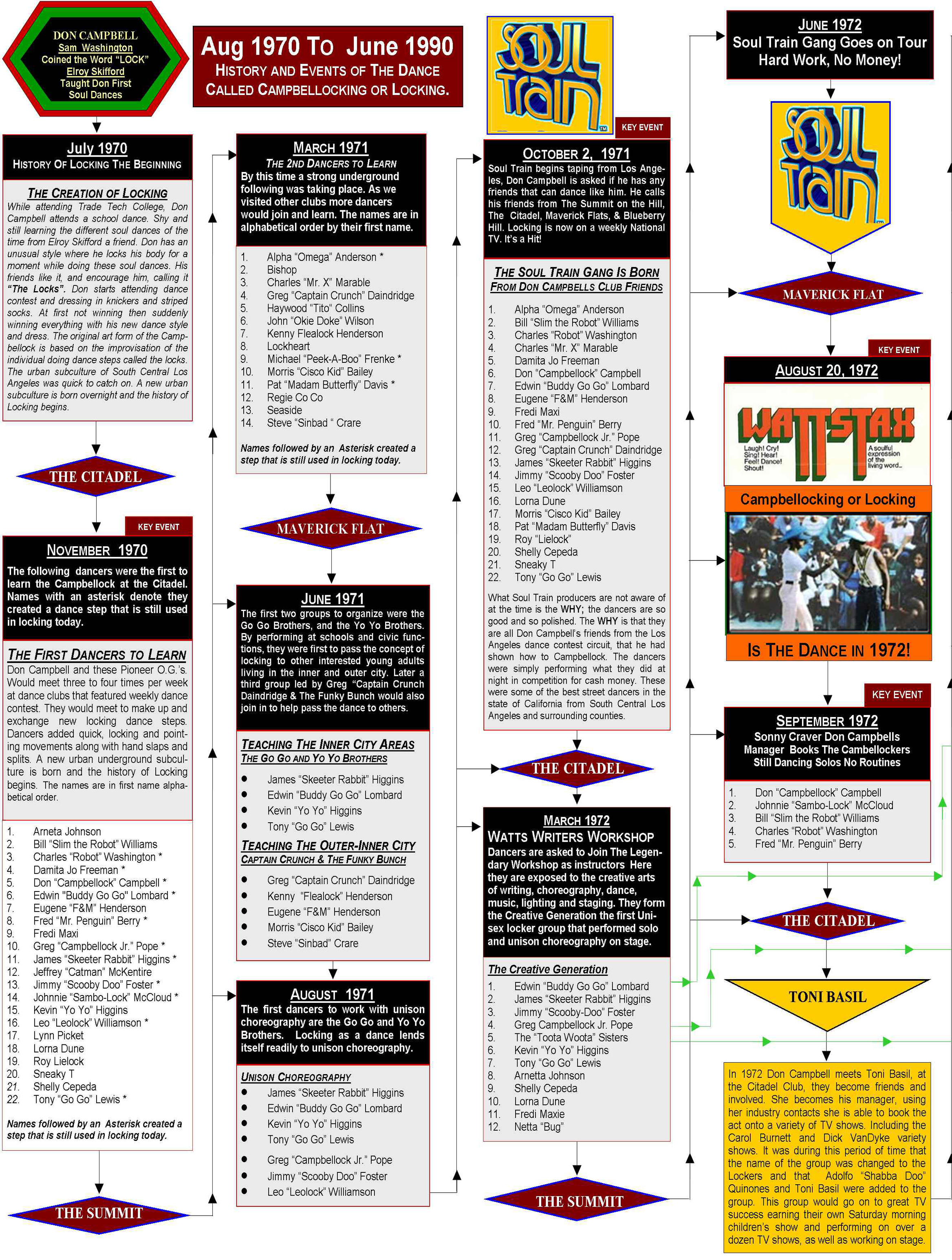 Open page at full size
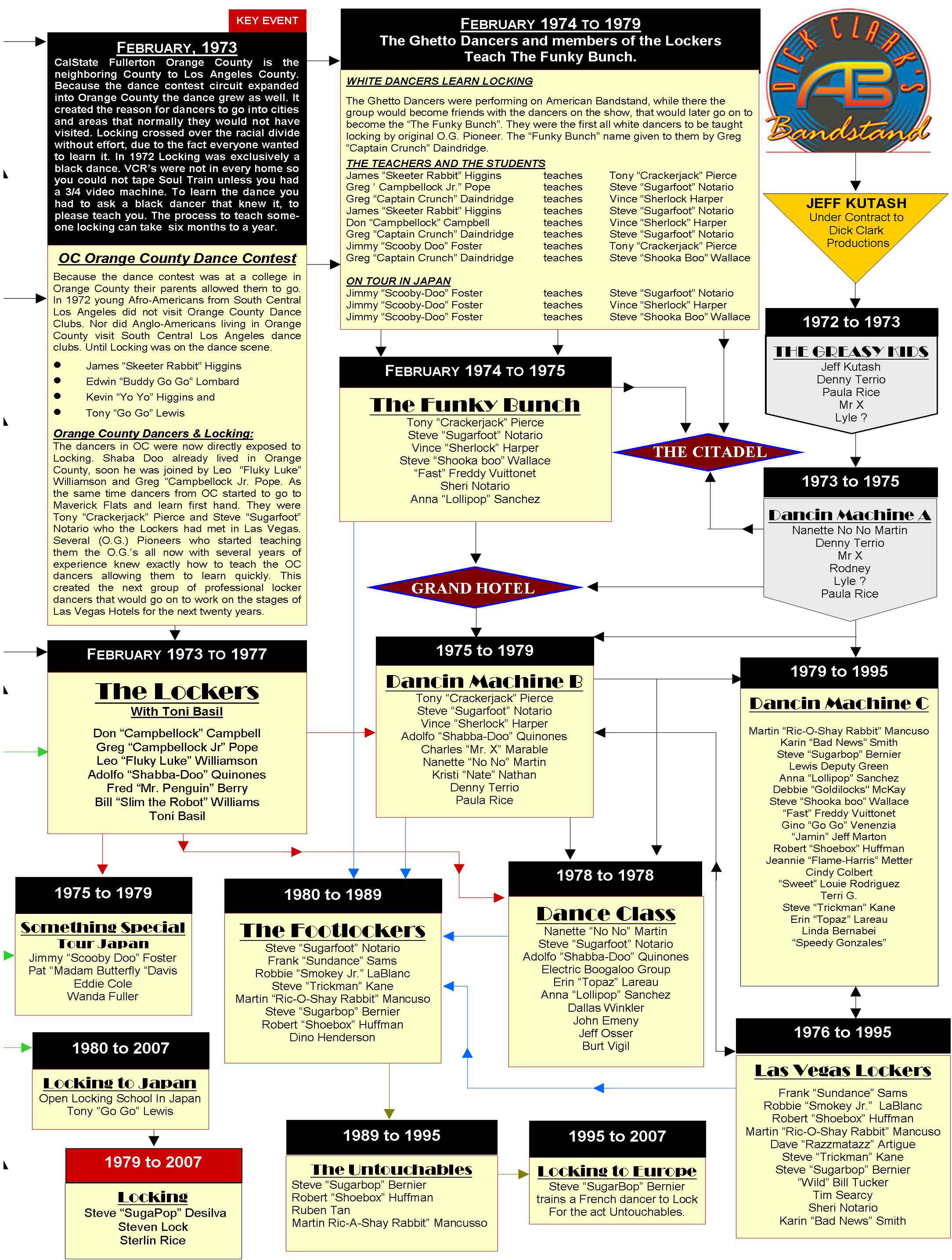 Open page at full size